
Small Steps, Big Learning: How to Experiment with AI
Key Takeaways
- AI adoption isn’t about making big bets — it’s about testing what works in real situations.
- Small, focused experiments reduce risk and build confidence across the team.
- You don’t need a strategy doc to get started — just a clear challenge, a few willing people, and space to learn.
- Think of experiments like sprints: short, structured, and user-centred.
- Teams don’t need AI expertise — they need permission to try.
Not Sure Where to Start? That’s the Point.
The biggest blocker to AI adoption isn’t the tech — it’s the pressure to get it right. Many teams don’t start because they don’t know where to start.
“We’re waiting for the right use case.”
“We don’t want to get it wrong.”
“We’re just watching what others do first.”
That’s exactly why small, structured experiments are so useful. They give you a way to learn as you go — and build confidence through doing, not just talking.
What Makes a Good AI Experiment?
AI experimentation doesn’t need to be complicated — in fact, the best experiments are the simplest.
Here’s what we’ve found works well:
- Real task: Something someone is already doing
- Clear goal: What are we trying to learn or improve?
- Quick cycle: A few days or weeks, not months
- Willing team: Volunteers who are open and curious
- Low risk: Mistakes are fine — that’s the point
It’s not a case study. It’s a test.
How to Choose What to Experiment With
Start by asking:
- “What’s slowing us down?”
- “Where’s the friction?”
- “What’s repetitive or draining that we wish was easier?”
Then try a simple challenge-based structure:
“How might we use AI to help us [insert task] in less time, with less stress, or with better results?”
It might be:
- Drafting internal updates
- Analysing post-event feedback
- Structuring a proposal
- Writing a first version of a policy
- Summarising a call or meeting
If the outcome helps someone think more clearly or work more efficiently, you’re in the right place.
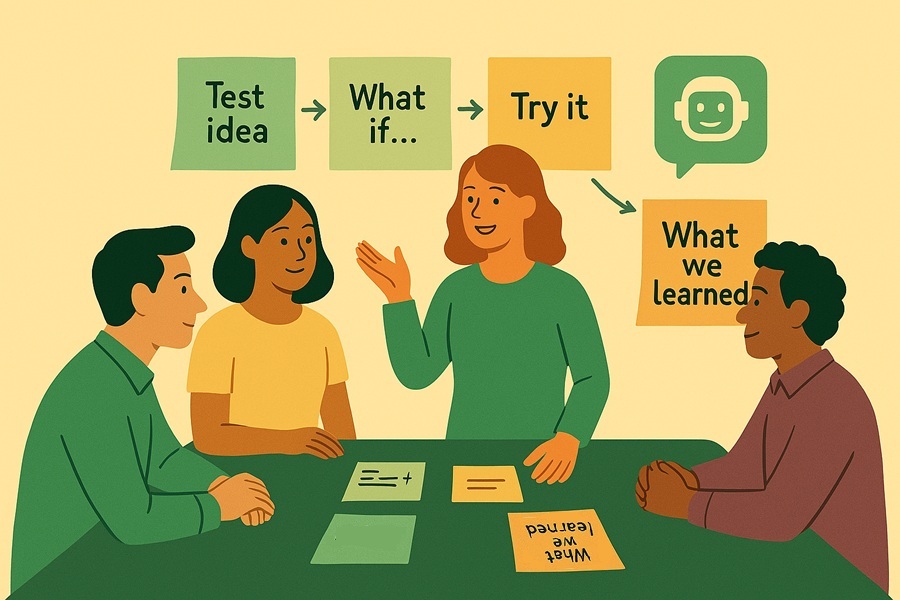
Think Like a Sprint, Not a Project
You don’t need a project plan or roadmap to experiment. You need:
- A rough idea
- A couple of real users
- A short window of time
- A follow-up moment to ask: “What worked? What didn’t? What now?”
If you’ve used design thinking before, this will feel familiar. It’s not about building the perfect solution — it’s about learning quickly, together.
Use AI as a Thinking Partner, Not Just a Tool
In all our experiments, we invite teams to interact with AI tools as collaborators — not as systems to be trained or mastered.
You can prompt tools like ChatGPT with:
- “How could we approach this differently?”
- “What are three different ways we could test this idea?”
- “Can you summarise key insights from our notes so far?”
And then you can ask:
“What do we still need to decide for ourselves?”
That’s where the thinking happens — and that’s where trust grows.
Why Small Experiments Lead to Big Shifts
A single experiment won’t change your organisation. But the impact goes beyond the test itself.
Done well, a small experiment:
- Builds team confidence
- Sparks new ideas
- Makes AI feel real, not abstract
- Gives leaders something to build on
And maybe most importantly:
It turns people from spectators of change into participants in it.
Let’s Explore AI Together
If you’re not sure how to begin, start by running a small, safe experiment that matters to your team.
At Maine Associates, we help teams frame meaningful challenges, choose the right tools, and run practical tests that build confidence.
Our Explore AI Together programme is built around experimentation, not just education.
Want to try something real — and see what happens? Let’s start with a conversation.